


Day 3 - Dog Musher's Camp at Juneau

Day three, June 10, 2026 – Juneau
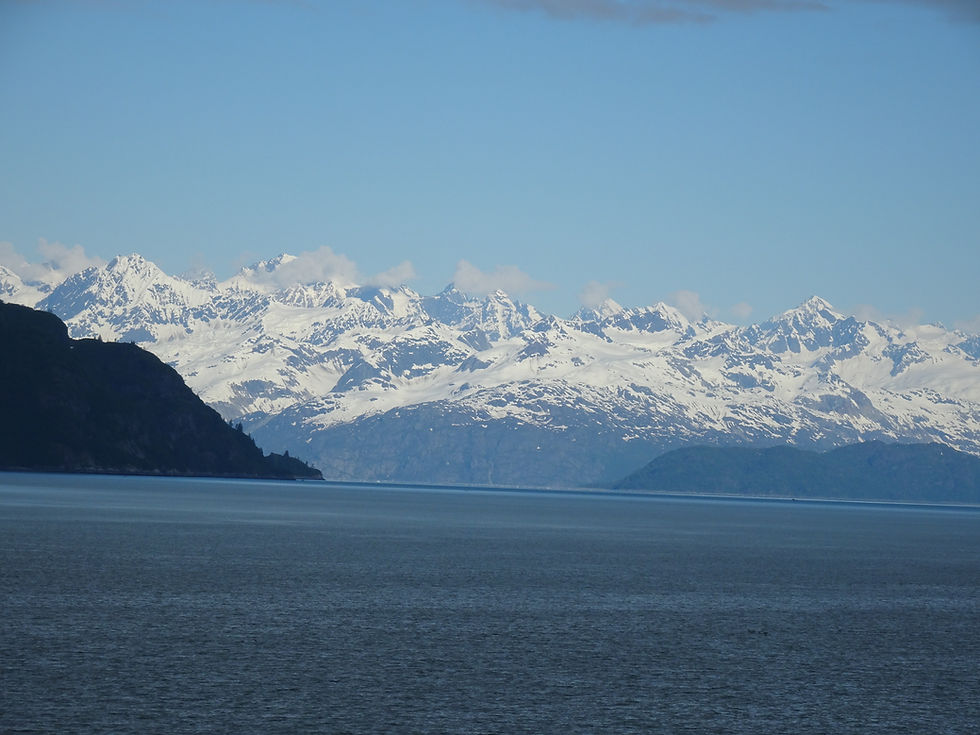
Juneau is the capital city of Alaska and holds the distinction of being the only state capital in the country which cannot be accessed by roads. We are learning this fact about a number of places in Alaska, which only serves to reinforce our decision not to drive to Alaska.
Juneau can only be accessed by air or by sea and the cruise ships which visit here swell the population by 50% on any summer day. The main industry here is state government with tourism being the second.

Instead of touring the city, we opted to visit a musher camp located in the beautiful Tongass National Forest – 17 million acres of forest, fjords, glaciers and mountains. Mushers are the drivers of dog-sled teams. They are responsible for guiding and training the dogs and maintaining their health. Mushing is Alaska’s official state sport, harking back to a time when dog-sleds were an essential method of transportation. The 1000-mile Iditarod is the most famous of these races and has been the subject of numerous books and movies. It pays homage to a life-saving relay of dogsleds which transported vital medicine to the town of Nome during a diptheria outbreak that occurred during a winter so brutal that all other forms of transportation were impossible.

The dogs must be trained year-round and the camp we visited had teams of dogs which were between 2 and 5 years old and therefore still training. During the summer, the dogs pull wheeled sleds through the thick forest on narrow dirt trails. Once the snows arrived, of course, they switch to sleds.
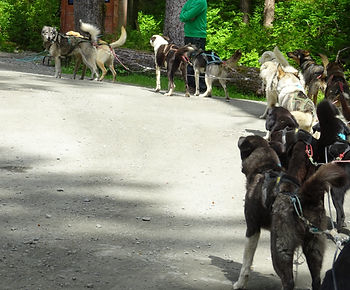
When our bus pulled into camp, the dogs were barking and jumping with excitement. Some of them were wrestling around, crossing over to the other side of the harnass and generally acting like excited pups.

Jim and I were assigned to sit in the front of the wagon and were instructed to fasten seat belts. Other passengers were loaded in the back 2 seats and the musher climbed on the back. Our musher was a young man in his early twenties. He talked to the dogs, untangled their harnesses and told us about their training process. This particular team has participated in some 100-mile races, and he hoped to complete a 300-mile race with them at the end of the summer. The dogs run at about 10 mph – they can run at this pace for long distances. But for every 10 miles they cover, they need to rest for an hour. So if they run for 40 miles, they need to rest for 4 hours. They can then repeat this process for as long as necessary.
The dogs are extremely well cared for. On long winter runs, the musher will cook hot meals for the dogs and make them beds of straw for sleeping. The dogs will wear little booties on their feet – not for warmth but to keep snow from compacting between their toes, which can cause bruising and could make a dog lame. The musher will sleep outside with the dogs in a “mummy” type sleeping bag because carrying a tent would add to the weight in the sled and increase the set up time during rests.

As we were sitting in the sled waiting to begin our run, we were amused with the antics of the dogs – barking and generally goofing off. But when the musher climbed on the back of the sled and gave the command to start running, their attitude changed completely. They stopped barking and fell in line behind the lead dogs and started running. The force of their takeoff threw us back in our seats with surprising force. Ten mph may not sound fast, but we were flying through the forest, especially on turns and hills. The turns would throw you from the sled were it not for the seatbelts. The dogs are attached to the sled with a harnass, but there is no rein for the musher to control the dogs. They are controlled simply by the voice of the musher – straight, gee and haw for right and left turns, and whoa to stop. There is a brake on the sled that the musher can use to monitor the speed. It was so amazing to watch this team of dogs and man – as they approached a fork in the road the musher spoke the command and the entire team of 15 dogs moved like a machine, and we passengers just held on for the ride.
One surprising fact was that the dogs were not large huskies, as is often pictured in movies and shows. All of the dogs were mixed-breed working dogs. All were part huskie, but some looked more like small labs, and others show traits of greyhounds. They are lean and weigh about 60 lbs. Despite their small size, they eat about 8 cups of kibble a day when they are training, which is about 3000-4000 calories a day (that’s about 4 times what our Springer Spanial eats).

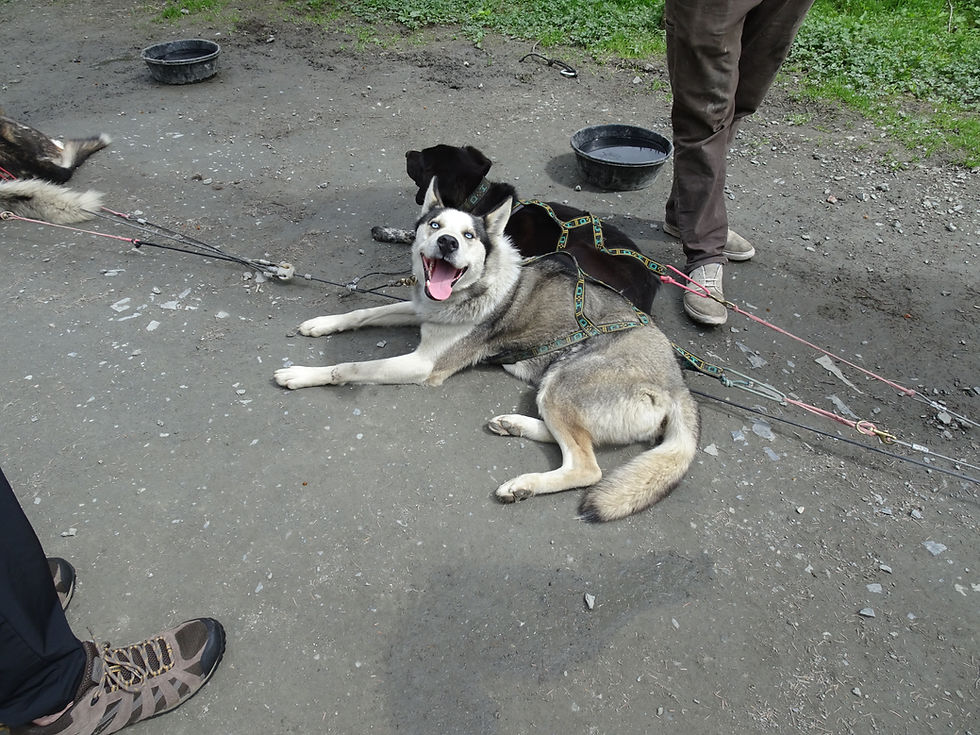
At the end of our ride, the dogs were told to rest, and most of them sat or laid down and they were given bowls of water. We were encouraged to pet the dogs and talk to them. I was shocked at how hot they were on this cool morning, but they had worked hard. Some of them clearly loved the attention and nuzzled us to encourage more of the same.

One important aspect of training these dogs is to socialize them, and we were to more than willing to assist in this effort. We were taken to a pen of young puppies and instructed to hold them, snuggle them, and help them get used to people. Of course we were happy to oblige. The puppies were adorable and snuggled and whimpered as they were passed from person to person.
The camp had a nice fire burning and offered us hot drinks – coffee, tea or cocoa after our ride and “puppy training”. Reluncantly, we boarded the bus and returned to Juneau, where we once again boarded our ship. The whole experience lasted about 3.5 hours but will stay with us for much longer.


Comments